
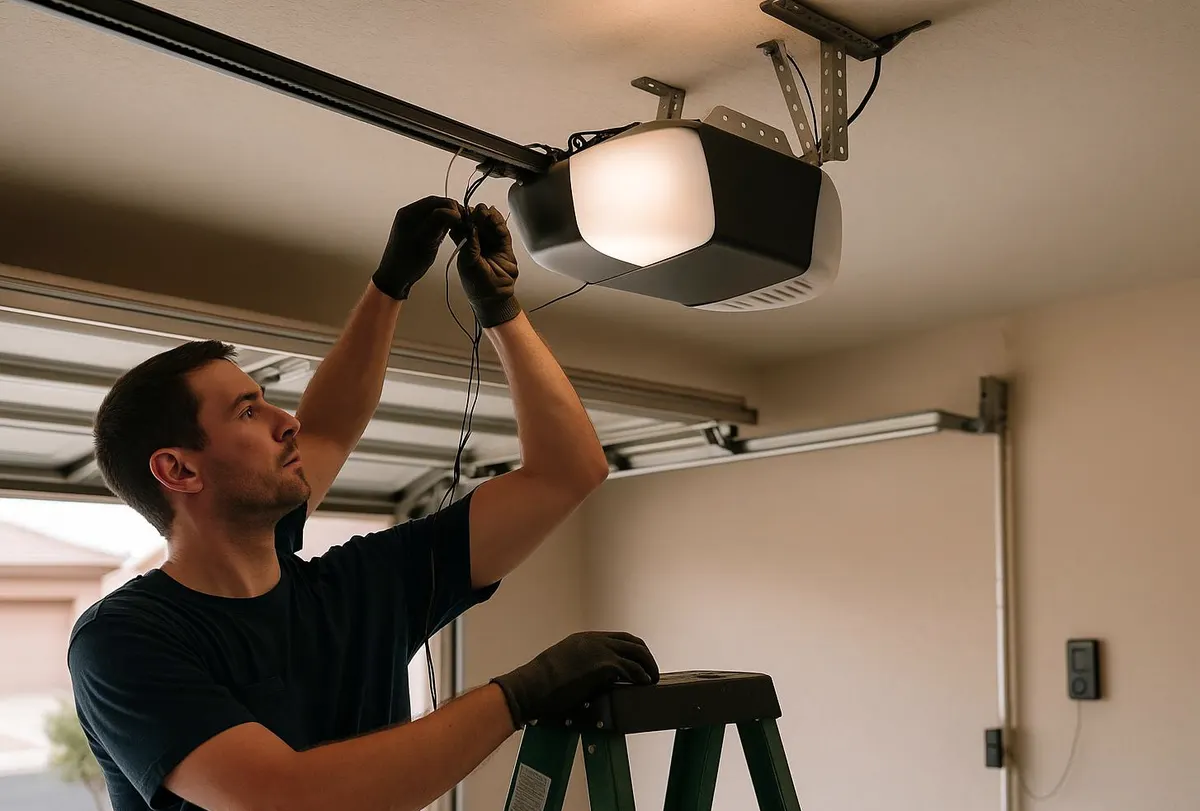
The Mistake Most Homeowners Make First
The door won't budge, you're already late, and the remote is right there in your hand — so you mash the button again, or go outside and yank on the handle. It's the obvious move, and it's tempting because it sometimes works. The trouble is that forcing a door that's genuinely stuck can strip opener gears, bend a track, or snap a cable that was already fraying. In Sumter County, where overnight humidity and dew are heavy for much of the year, a door that feels 'frozen' is almost never actually iced over. It's stuck for a mechanical reason, and figuring out which one matters before you apply more force.
What You'll Notice First
- The door stutters or jerks instead of moving smoothly along the track.
- The opener motor strains, makes a louder-than-usual hum, and then reverses or stops.
- The door feels unusually heavy when you try to lift it manually.
- It sticks at the very bottom, as if the weatherstripping is glued to the slab.
- Grinding or squealing comes from the rollers or springs as the door moves.
None of these symptoms tell you the cause on their own — that's what a technician works through methodically, starting at the point of contact with the ground and moving up through the hardware.
Cause #1: The Bottom Seal Is Stuck to the Slab
This is the first thing worth checking, because it's the simplest to fix and the easiest to mistake for something worse. After a heavy dew or a cool snap, moisture can sit between the rubber weatherstripping and the concrete overnight. The rubber swells slightly and temporarily adheres to the slab. The fix is to gently break the seal by hand along the bottom edge before triggering the opener — never force it from the opener side. If the weatherstripping is cracked, flattened, or swollen beyond its normal shape, it should be replaced; that's a quick, low-cost repair and it prevents the same sticking from happening again.
Cause #2: Dirty or Corroded Tracks
Next, a technician runs a hand along the inside of both tracks feeling for grit, dried pollen, or a rough, pitted texture. Florida's humidity speeds up surface rust on steel tracks and rollers, especially in homes closer to open, breezy areas where salt air carries further inland than people expect. Rust creates friction the rollers have to fight through, which shows up as jerky, uneven movement. The fix is cleaning the tracks with a dry cloth and mild degreaser, then applying a silicone-based lubricant made for garage doors — not WD-40, which attracts dust and grime over time.
Cause #3: Stiff or Under-Tensioned Springs
Springs are checked next because they do most of the lifting work, and any lubricant on them thickens slightly in cooler temperatures, adding resistance right when the door needs it most. A technician looks for visible gaps in the coils, uneven spacing, or a spring that looks stretched compared to its partner. Lubrication is a quick fix if the spring itself is healthy. If the spring has lost tension or shows wear, that's a repair job — and it's one homeowners should never attempt themselves, since a torsion spring under load can cause serious injury.
Cause #4: Worn or Rusted Rollers and Hinges
Nylon rollers can dry out and crack, while the metal stems and hinges they're mounted on corrode from repeated exposure to humid air. This adds drag at every point where the door changes direction along the track. The fix is usually replacing worn rollers with sealed-bearing versions, which hold up better in Sumter County's moisture than standard ones, and lubricating the hinge pins.
Cause #5: Opener Gearbox and Limit Settings
If the door is smooth by hand but struggles with the opener, the issue often lives inside the unit itself. Grease in an older opener's gearbox can thicken with age and temperature swings, making the motor work harder and eventually strip a plastic gear. A technician checks the force and limit settings first, since those are a quick adjustment, before deciding whether the gearbox needs servicing or the opener is due for replacement.
Cause #6: Frayed or Loose Cables
Last, the lifting cables get a visual check near the bottom bracket and drum, where fraying usually starts. A door that feels heavy or sits slightly crooked when stuck can point to a cable that's lost tension or started to unwind. This is a repair, not a lubrication fix, and it's worth catching early — a snapped cable mid-lift can let a door drop suddenly.
When to Call Bushnell Garage Door Pro
If breaking the bottom seal doesn't solve it, or the door still jerks, grinds, or strains the opener after a basic cleaning, it's time to call in a technician rather than keep testing it yourself. We handle Garage Door Tune-Up & Maintenance to catch rust, worn rollers, and thickened lubricant before they turn into a stuck door, and Garage Door Cable Repair when fraying or tension loss is the real culprit. We serve Bushnell, Webster, Wildwood, Coleman, Center Hill, Lake Panasoffkee, Sumterville, and The Villages.
If your garage door is sticking, straining, or stopping partway, call Bushnell Garage Door Pro today and we'll get it moving smoothly again.